
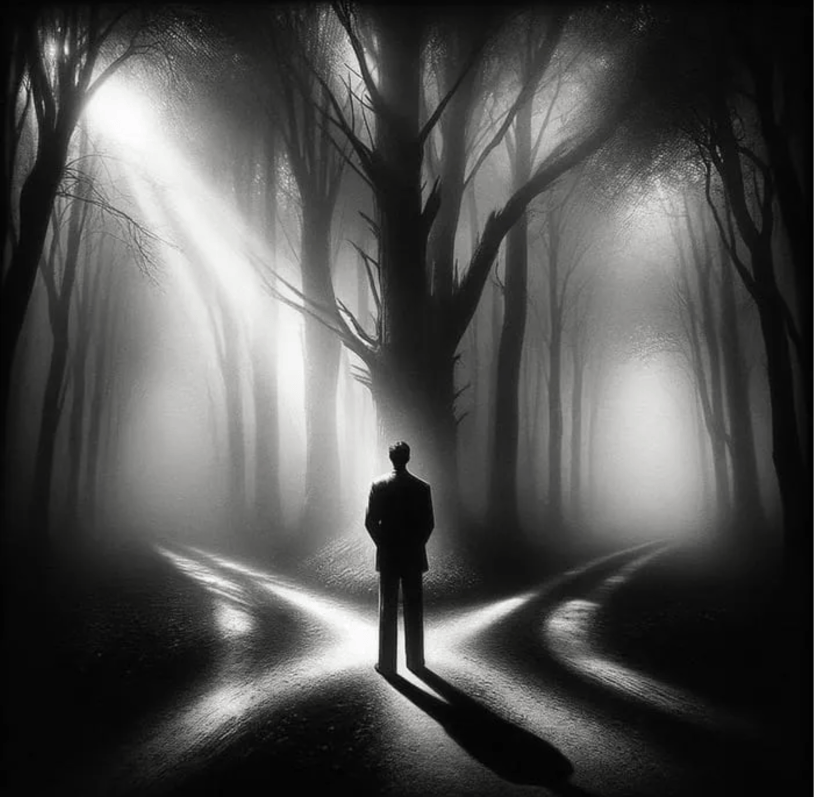
How do we know what is right and what is wrong?
Why do we feel good after doing something that we believe is right, but guilty after betraying our own moral boundaries, or what society believes is morally incorrect? After all, doesn’t every moral reaction stem from our upbringing, which is influenced by society itself?
And we rarely stop to question it. We simply know, or we think we do.
Recently, I reminisced about my childhood memories, picturing those times when Mom read me moral stories about kindness, fairness, and being good. I was taught that honesty is right, selfishness is wrong, kindness shapes our character, and so on. Our parents teach us, our schools teach us, our religion teaches us, society creates norms about right and wrong, and we accept them.
But did we ever choose any of them? And where do these ideas come from?
Are they merely human agreements passed down over generations, is it the result of our upbringing, or is it a higher order like God or religion, something that billions have looked to for answers
Religion has answered many questions that you, me, and mankind still haven’t been able to answer. It has given many a purpose, a right path to follow, a fundamental idea to uphold and has become a necessity for many in the modern world. Hindu traditions speak of dharma and karma. Christianity emphasises love and forgiveness. Islam stresses justice. Buddhism tries to reduce suffering through compassion, and Sikhism focuses on selflessness and seva.
Different beliefs. Different histories. Different stories. Different faiths. Different legacies.
Yet every idea links to something bigger, something that is accepted to be morally right across the world. Every belief and tradition of every religion is a drop in the same ocean of virtues. Different beliefs and traditions might germinate from different seeds, different stories, but they all lead towards the same fundamental goal: living a righteous life, a life that society believes to be right. So, perhaps religion does not tell us what’s right. It just gives us a reason to follow the right path, the path of the society that we believe is right.
But after rethinking and questioning it night after night, I started wondering, “What happens when someone stops believing in God? An atheist isn’t evil, right?
But if one becomes an atheist, where does his morality come from? If there is no heaven to earn, no hell to fear, no idea of salvation, no God to watch over us, why should one still choose to do what is right?
Maybe it is empathy.
Maybe it is our upbringing.
Maybe it is our experiences.
Maybe it is reason or logic.
Or maybe something we cannot explain.
Our conscience, perhaps.
We could lie; we could hurt someone who cannot retaliate; we could steal something that is not ours and never be caught. Yet, many of us don’t do it because something, something deep within ourselves resists it.
We all have a conscience, some level of societal understanding and a picture of what is right. Think about it, does this information and understanding not lead to another question? A question that we should answer, based on our distinct understanding of society.
If we can be moral without God, was God ever necessary for morality and mankind?
I don’t think any of us can answer this question with a simple yes or no.
Even if religion didn’t create morality, it has shaped how humans understand it. 8.3 billion more people like us share this planet, and more than 6 billion people worship and believe in a deity. This means that religion has become a necessity, inspiring people to act righteously. It has given people a sense of global responsibility through fear, love and teachings.
Yet, we still may choose to reject religion, walk away from it, even after everything mankind has gained from it. However, even after one consciously rejects religion, its influence rarely disappears entirely. We still hold on to the values religion has instilled in our culture over the course of time.
Some may not believe in karma and still think that what you put out into the world eventually finds its way back to you. Some may question their religious teachings, yet be connected to family traditions and festivals. Some may call themselves non-religious, but still carry ideas about duty, purity, or sacrifice that they have inherited without ever actually choosing them. This portrays how culture is deeply intertwined with religion, so that it might sometimes preserve the values and teachings of a religion, silently weaving it into our everyday lives even after one has rejected or forgotten those ideas.
Religion can become culture. Culture can become a habit, and habit can become instinct.
And writing about this makes me wonder about myself. How many ideas of right and wrong did I actually arrive at on my own? How many did I inherit from my family, my culture, my school or my society? And if I had grown up somewhere in Afghanistan, Norway, Egypt or a different corner of the world, would I have thought that my current opinions are stupid?
We are growing up in a rapidly changing world, and we often see parts of it in ways others do not. And maybe, growing up in this world isn’t just learning what to believe. It is about deciding what must be believed.
That doesn’t mean that we should reject religion. It doesn’t mean that we accept it either.
As the citizens of tomorrow, we must ensure that everyone feels safe practising their beliefs. Hence, we can appreciate the values that religion has given us while questioning the assumptions and the inequities brought along with it.
So maybe the real question isn’t whether religion or “God” taught us right and wrong. Perhaps it’s about whether we have ever stopped to ask why we believe what we believe, why we think something is right or wrong in the first place, and whether it is really our decision.
Would we still choose to be kind if no one told us to be kind? Would we still choose to be honest if we were not punished for lying? Would we still help someone even if they would not help us in return?
I don’t know where morality and right and wrong begin.
But that uncertainty is why we should keep asking,
Not only about who taught us right and wrong,
But after everything you, me and mankind have inherited,
Do we still choose to believe it?
Written by Sai T, Staff Writer at The Woodstocker
Edited by Tisya K and Arjuna T, Editors at The Woodstocker


Nicely expressed Sai. Look forward to reading more of your work.
LikeLike
YE KYA HAI
Get Outlook for Machttps://aka.ms/GetOutlookForMac
LikeLike