
Picture: Zee News
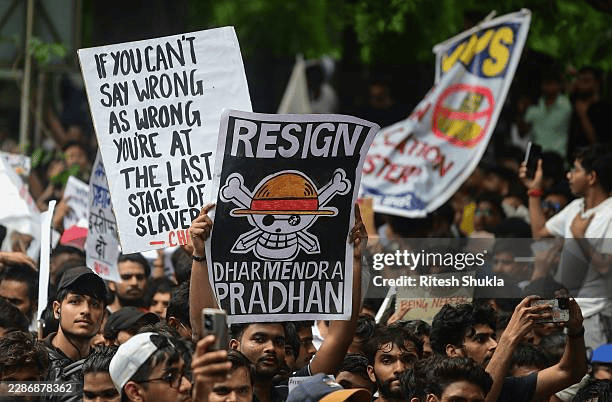
I’m pretty sure all of us have encountered innumerable satirical reels about the Jantar Mantar protests and Cockroach Janta Party ranging from rain-dances in Bihar to Subway Surfers in Delhi. It is also where conventional banners were replaced with noteworthy cardboard posters in lowercase that seemed less like institutional demands and more like a collective comprehension that the system is, in our words, cooked. I’ve got to admit this is probably the most amount of FOMO I’ve felt (it genuinely felt like they had the time of their lives), but there’s a larger picture that most of us probably failed to observe.
For those of you who aren’t chronically online, the Jantar Mantar protest was a massive youth-driven political movement triggered by the NEET 2026 paper leak and fundamental flaws in the CBSE On-Screen Marking System. This demonstration was further fueled by the suicide of 21 NEET aspirants, enraging millions around the nation.
And to compensate, there were several reasonable demands laid out:
- Resignation of the Union Education Minister Dharmendra Pradhan
- Strict measures against those who caused the leak
- Structural and systemic reforms in the Indian Education System
- Monetary compensation for the families of the victims
For those that don’t quite believe these demands are rational, don’t you think these conditions are rather inadequate to make up for the 2.2 million students who spent years preparing for this exam? Only to be hoaxed.
I believe that this whole front was quite efficacious in terms of bringing the issue to limelight, but how effective was it in terms of creating definite impact?
To begin with the most prominent change, Mr. Dharmendra Pradhan did resign from his post as the Education Minister, replaced by Mr. Pralhad Joshi. In my opinion, this factor alone provides sufficient evidence that this movement was successful. However, there are several speculations on social media that believe Mr. Pralhad Joshi is likely to be a figurehead. (a figurehead is an individual who holds an authoritarian position but in actuality possesses little to no power or de facto control)
Consequently, ideas of Mr. Pralhad Joshi acting as only an institutional front implies that all decisions concerning the native curricula are often derived from other agencies. This frames our education minister as a superficial executor of pre-determined policies rather than a liberated policymaker. Considering the new minister as a mere figurehead underscores a cavernous and troubling reality: True accountability requires doing MUCH more than just announcing a single resignation.
To continue, does this really bring justice to the educational system of India? Above all, the resignation of a minister is placing accountability on a single individual, not necessarily on an entire system. In hindsight, India has encountered several challenging matters in terms of a plethora of paper leaks. To what point can all of us impute this faulty cycle upon one minister? The rudimentary issue is rooted within the administration as a whole that the aspiring youth of the nation relied on. Replacing a minister cannot, by itself, replace the system. After all, I wouldn’t enter the examination room after the appointment of a new minister, still wondering whether the test that determines my future is fair.
In a similar vein, the CJP demanded that each victim’s family receives ₹1 crore as compensation for their bereavement. Whilst this is a generous amount, can we really put a price to the persistent and adamant efforts of those kids? How could we possibly monetize their time invested, loss of opportunities, trust and above all their lives in a mere examination system? We are discussing the loss of 21 individuals and 21 families losing their loved ones. This devastating loss is profound because it alters the national narrative from an administrative fault to a human crisis. Is money adequate enough to recompense a future already imagined and lost?
On the contrary, one could consider the widespread dominance of the youth agency as a victory. With a ludicrous amount of people protesting around the nation, this issue became the highlight of the national political discourse. What resulted from the NEET paper leak became advocacy against large-scale unemployment, economic instability and the inaction of the government to execute proficient reforms. Eventually, these issues were addressed by the Prime Minister on social media in which he also stated he would be consistently active and engage with the youth in order to empathise with them. Whilst this showcases initiative, there is a noticeable distinction between being heard and being listened to that is yet to be determined.
During July, this year, thousands marching towards the Parliament were violently suppressed by the police using batons and tear gas canons. Roads were blocked, Metro stations shut, mobile internet services were restricted and the infamous “Lathi Charge” was imposed. To shed some light on its significance, the Lathi charge is a crowd-control strategy that is primarily used by the legislative government wherein police officers use long, substantial bamboo sticks to forcefully disperse gatherings. Unfortunately, in this case, these ‘lathis’ had metal nails hammered into them. This is extremely risky as these nail embedded weapons can cause deep, jagged puncture wounds that tear open blood vessels and cause exsanguination. Moreover, rusted nails can introduce threatening bacteria directly into deep tissue, causing sepsis, gangrene or tetanus.
While these measures can be framed as arguments to maintain safety and security, the question still arises: how much disruption is a democratic nation willing to tolerate in exchange for dissent? Personally, I believe there was an incessant use of violence by both parties like protesters pelting the police force and lathi charge, in a situation that could’ve been managed rationally and diplomatically. It was genuinely heartbreaking to witness those who suffered severe injuries due to tear gas, pellet and puncture wounds, lathi charge and excessive ferocity, especially during a movement that was meant to be ‘peaceful’.
Ultimately, a question remains.
Was justice served?
Yes, people were held accountable. The minister resigned.
But justice can be defined as far more than a resignation or a large amount of money.
Justice may be defined as ensuring full accountability from every individual responsible for the hardships endured by students and protesters. Justice could mean ensuring every future examination remains fair and confidential. Justice could mean students never having to resort to peaceful protests out on the streets instead of studying in their rooms.
The real answer? It’s still being written.
It won’t be authored by administrators sitting in air conditioned offices, it’s going to be us. As of now, the banners may be cleared and the algorithms have followed new trends but the disillusionment lingers. They heard our rage, yes. Nevertheless, until a student can set foot into an examination hall unwary of the system’s integrity, the state has not listened. After all, you cannot suppress the very future you are attempting to meticulously construct.
Written by Dia R, Staff Writer at The Woodstocker
Edited by Tisya K and Arjuna T, Chief-Editors at The Woodstocker

