
An Investigation Into The Accent, Vocabulary, and Strange Linguistic Ecosystem of The Hill
Woodstock is, among other things, a strange linguistic experiment. Take several hundred impressionable teenagers from different countries, cultures, cities, backgrounds and schools, put them on a hill, have them share classrooms, dorm rooms, dining tables, and keep them within each other’s orbits for long enough. What happens? Well, they might start sounding a lot like each other. At least, that’s the theory: somewhere between unmistakable Indian cadences, random American vowels thrown around, clipped remnants of British English, and an amalgam of accents that seem to have accumulated in several countries along the way, a distinctly Woodstock way of speaking emerges. Yet, one might wonder: is it a distinct accent or hybrid communication resulting from international education, diverse friend groups, residential communities, and routine code-switching?
As a new student, I have the slightly strange privilege of hearing Woodstock before I have fully learned to speak it. I notice things that people who have been here for years don’t notice anymore: how similar some voices are, how quickly accents change depending on who is speaking to whom, and how a single word can sound completely normal at Woodstock and make absolutely no sense anywhere else.
I must also first clarify that the word “accent” is used rather loosely to include not just the pronunciation patterns but also unique vocabulary, slang, expressions, conversation style, and perhaps intonation and cadence; in short, a Woodstock way of speaking.
Language is something we uniquely bring with us to Woodstock. It belongs to our parents, hometowns, countries, childhoods, and cultures. It seems as though it should be one of the most permanent and deeply ingrained parts of how we express ourselves. In truth, linguistic practices are far less fixed. Put enough people together who share a few dominant languages for long enough, and their voices begin to merge into this hotpot of inflections, tonalities and pronunciations: behold, the “Woodstock accent”.
THE WOOD·STOCK AC·CENT
noun |/ˈwʊdstɒk ˈæksənt/
Definition: A highly localised linguistic phenomenon characterised by an unpredictable amalgamation of American, Indian, British, Nepali, Ukrainian and other assorted international influences developed at Woodstock School. Occasionally interrupted by words that appear to exist exclusively within this 300-acre radius.
Possible causes include:
- Prolonged exposure to other Woodstock accents
- International-school osmosis
- Roomates
- Friend groups
- Teachers/staff
Nobody sits down one day and decides to “acquire” a Woodstock accent. There is no orientation session or pronunciation workshop; it just happens. You arrive with your own voice, then someone else’s voice starts rubbing off on you. You pick up a phrase from your roommate, a pronunciation from a friend, a word from your classmate. Perhaps you start spending more time around someone who speaks slightly differently, and before long, you are saying the same thing in a way you would have found completely foreign six months ago.
Some students can apparently transition between accents almost on command, switching from an American-sounding voice to a distinctly Indian one and back again depending on who they are speaking to at that moment. Others arrive with particularly strong accents and over time find themselves sounding increasingly like people around them. Students who have spent their entire lives in international schools also bring pronunciation patterns and speech habits shaped by those environments into the mix. Through constant interaction, these patterns can become absorbed into wider friend groups, dorm communities and classrooms, which makes it increasingly difficult to tell where one influence ends and another begins.
This phenomenon might be best described as “Woodstockification.”
WOOD·STOCK·I·FI·CA·TION
noun |/ˌwʊdstɒkɪfɪˈkeɪʃən/
Definition: The gradual process through which a person’s accent, vocabulary, pronunciation or general speech patterns become increasingly Woodstock-esque after prolonged exposure to the school community.
Apparently, the phenomenon isn’t entirely invisible to those outside of the Woodstock community. The Global Alliance for Innovative Learning, or GAIL, is an international collaboration between schools that brings students from diverse communities together through conferences, exchanges, and collaborative projects. At a GAIL conference, students from other schools reportedly noticed that Woodstock students seemed to share an accent; that somehow, despite coming from vastly different backgrounds, we all seemed to sound alike. This, then, raises the obvious question: what exactly are they hearing?
Of course, the Woodstock accent isn’t just linguistically confined to what comes out of our mouths. There is also the small matter of what, exactly, we choose to call things. Sometimes, you can identify a Woodstocker without listening to their accent at all. You just have to pay attention to the lexicon they use. Widely-used terms consist of:
QUAD
noun |/kwɒd/
Definition: A multipurpose social ecosystem situated approximately at the centre of campus and responsible for a statistically significant proportion of spontaneous conversations, games of four-square, loud music, meals, events, and Early Years children running around.
TUCK
noun | /tʌk/
Definition: Snacks, food and sustenance available for purchase at certain times at the dorm store. Also: a reliable source of satisfying campus-wide anticipation.
WIN MUM·BY
noun | /wɪn ˈmʌmbi/
Definition: A gym named in honor of Win Mumby, though its significance extends considerably beyond the fact that it’s a building. It is where endless PHE classes happen, lunch breaks are spent, chapel services are held, sports events unfold, and numerous school memories accumulate.
TAN·GER·INE
noun | /ˌtændʒəˈriːn/
Definition: Officially named Winterline, but universally still known as Tangerine. A place where drinks are served, but where the real currency is time spent together. Friends meet here between lessons, before/after school and whenever there is an excuse to sit down for a while. A Tangerine can also be a promise if it is owed, and a small act of kindness when a friend happens to have forgotten their money and someone else covers the expense.
PAS·SAGE
noun | /ˈpæsɪdʒ/
Definition: An extracurricular ecosystem in which students voluntarily remain at school to acquire skills, develop passions, make friends, and discover that they are capable of things they did not know they could do.
FLEX
noun | /flɛks/
Definition: A legendary period of time, formerly occurring from 9:30 to 10:30 AM, during which students were generally free to do whatever needed doing. No longer with us. Deeply missed with an intensity usually reserved for much greater historical losses.
CFI
noun | /ˌsiː ɛf ˈaɪ/
Definition: The Centre for Imagination, or CFI for short. A place where ideas are encouraged to become projects, projects are encouraged to become something bigger, and “That’s probably impossible,” is not necessarily considered a sufficient reason not to try.
GOAL-A-THON/SWISH-A-THON
noun | /ˌɡəʊl ə ˈθɒn/ /ˌswɪʃ ə ˈθɒn/
Definition: Competitive and charitable athletic gatherings characterized by linguistically ambitious suffixes.
Then there are the words that don’t belong in any “official” Woodstock handbook. They exist somewhere in the foggy territory between slang, inside joke, brainrot, and linguistic inheritance. Their meanings shift between friend groups, grades, graduating classes, and sometimes the only qualification required to understand them is having been in the right conversation at the right time.
These words are also perhaps the clearest evidence that a school can develop its own language without ever deciding to create one. Eventually, the lexicon becomes ordinary. You stop translating them in your head, you stop noticing that they would sound strange anywhere else because they simply become part of the way you speak.
And perhaps that is what makes the Woodstock accent more interesting than any other. It is a record of proximity: proof that we spend years listening to one other. We borrow without noticing, and adapt without deciding to. In that sense, the Woodstock accent is more about accumulating voices along the way rather than losing the one you arrived with.
Which leaves me wondering again: when do you start speaking Woodstock? Is there a particular moment when it happens, or does the boundary between your own accent and the Woodstock accent simply become impossible to locate? At what point does a borrowed pronunciation stop feeling borrowed? When does an expression you picked up from a friend become something you use regularly? Will I eventually hear myself speaking and be unable to tell which parts of my voice I brought with me and which parts I collected here?
Perhaps that is the strangest part of all. There may never be a clear moment when I “start” speaking Woodstock, because there may never be a clean distinction between the voice I arrived with and the one I develop here.
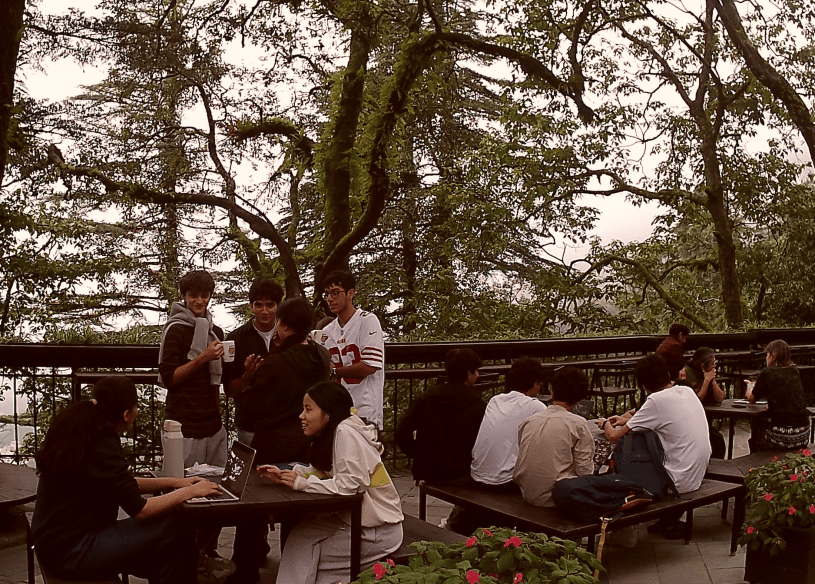
For now, I am still listening; to the voices moving through the hallways, crossing the Quad, spilling out of classrooms, drifting down the paths, and gathering around tables. Hundreds of people, carrying hundreds of different histories, somehow creating a sound that belongs to none of them individually, and yet, collectively belongs to Woodstock. Maybe that is what a place does when people stay long enough: it leaves a little of itself in the way they speak. And maybe, by the time I graduate, I’ll carry a little of Woodstock in my voice no matter where I go.
In the end, the Woodstock accent is admittedly just several people saying “bro” in slightly different ways.
Written by Mehrangaiz N, Staff Writer at The Woodstocker
Edited by Arjuna T and Tisya K, Co-Editors at The Woodstocker
 thewoodstocker.com
Wow!
LikeLike
[heart] Claire Brady reacted to your message: ________________________________
LikeLike