
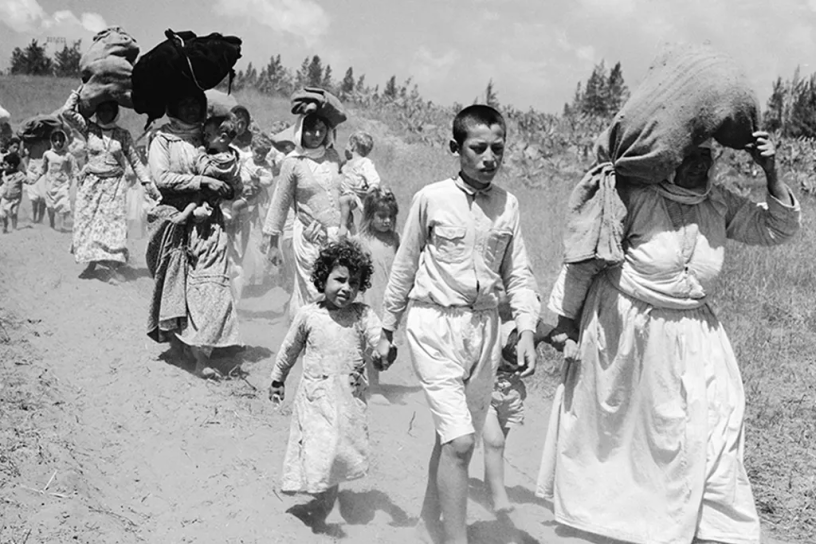
1948 Nakba – Image credit: Council on Foreign Relations
Advocacy is one of the most powerful things an individual can strive to participate in.
As a student who wants to make a difference, I personally believe that political consciousness is currently an increasingly important phenomenon — and it’s not too late to look at why.
In this age of convoluted issues, it is easy to forget that the people on the frontline of crisis are part of the reality beyond the bubble we individually fabricate. However, when that bubble eventually bursts, the utmost crucial viewpoint to maintain is that this world has undergone fascist regimes, numerous genocides, famines, ethnic cleansings, and countless armed conflicts — thus formulating eras that highlight the importance of awareness in the midst of various power structures.
Despite these having occurred before, diverting our view is inevitable as current commonalities within society seem to solely consist of distractions. Consequently, there is a constant aspect in each one of our lives that seems to pull our eyes away from facts.
As such, it is important to understand that current geopolitical crises are symptomatic of historical precedents. In our context, the documentation of this period will undoubtedly contribute to the everlasting historical timeline. The current wave of digital mobilization is just one of the emergent catalysts in contemporary politics. Journalists such as Bisan Owda’s documented experiences on social media can be compared to crucial diary entries, letters, and biographical works that came out of previous crises — effectively constructing our library of historical evidence piece by piece(@BisanOwda). Her persevering communication of the Palestinian devastation exemplifies the cruciality of understanding how minority stories — like hers — are often not accounted for in the ‘final draft’ of sociopolitical archives. This is why our generation’s overwhelming potential to drive political change gives way to so much hope, demonstrating that we can push boundaries such as media censorship.
For example, with profound events such as the graduation walk-outs at the University of Edinburgh, we can begin to see frequent non-violent protests against crises such as these. Debates over academic freedom, cancelled events, and various other restrictions contribute to the larger issue of restricted freedom of speech. And so, the concept of mass mobilization can give way to sociopolitical change despite media censorship.
Timeline
To further examine the historiography, the 1948 ‘Nakba’, the Arabic word for ‘catastrophe’, was an uprooting of several hundreds of thousands of civilians, creating a colossal and internationalized refugee crisis. This forced exodus sparked what is now one of the most devastating and horrific focal points in history. 78% of Palestine was thereby occupied territory, forcing families to flee to the Gaza Strip, West Bank, and neighbouring countries.
Through the 1950s and 60s, a series of back and forth with war, UN resolutions, and continued political disputes occurred. In 1967, the ‘Six-day war’ caused Gaza to fall under complete military rule. Over the next few decades, a similar series of events seemed to repeat and continue to intertwine with other regional discrepancies. Then the world saw the progression of The Oslo Accords, Paris Protocol, the Geneva convention, and Abraham Accords to name a few from 1993 to 2020. Despite numerous incentives to build a sense of order or attempt to align with international law, breakdowns in these international protections are increasingly evident, leaving us with a lack of verified information.
This issue then further manifested in the form of the October 7 2023 attacks alongside a further convoluted land dispute, extreme famine, and endless barren land. Here’s a before and after satellite view of Gaza in 2023 versus 2026 for reference:
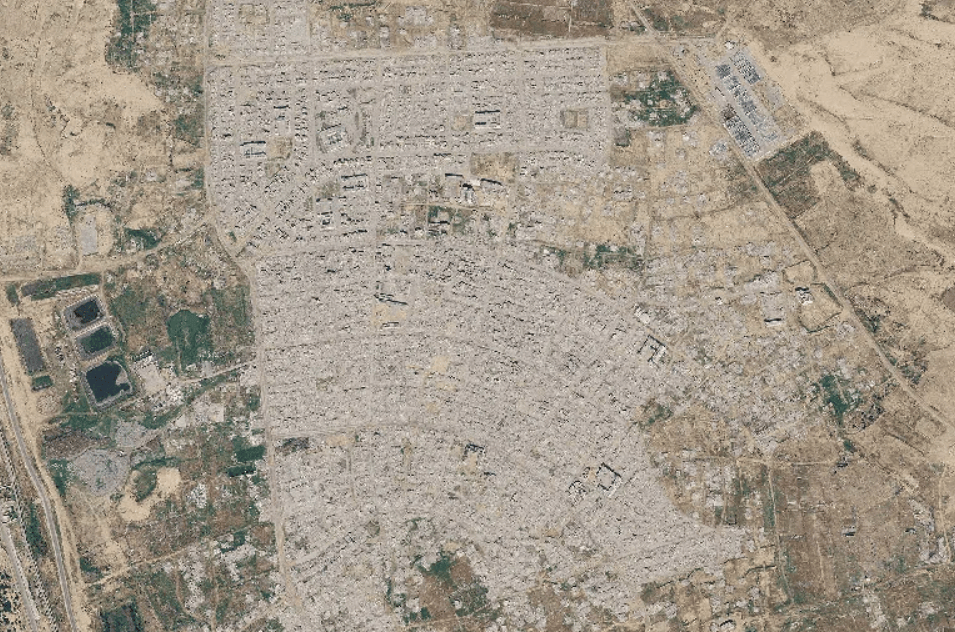
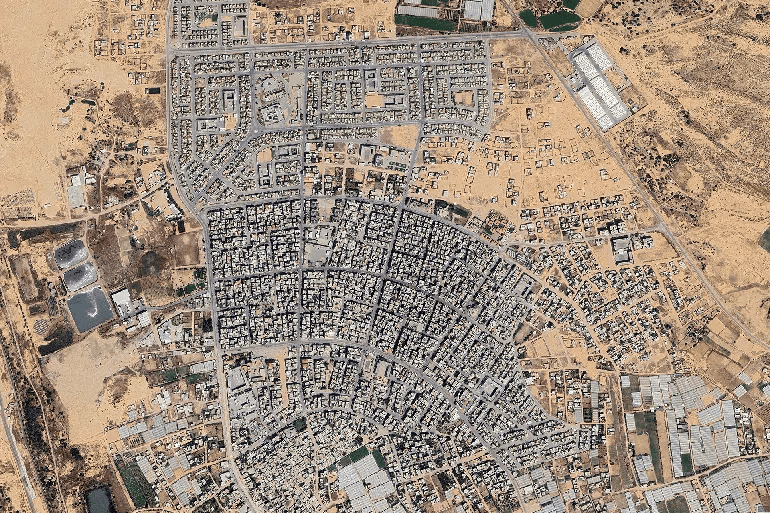
(Image credit: Al Jazeera)
It’s now three years later. Why aren’t we seeing more of Palestine, of the impact this issue is having on the people on the ground? To put it simply, the lack of reports coming out of Gaza is because of two reasons: severe safety risks for journalists, and the extreme decrease in the population of Palestinians altogether. This is important because it helps build the rest of the picture — and the reality is much worse than how it’s widely perceived. Conversely, international protections rooted in the International Humanitarian Law (IHL) alongside United Nations mandates help provide positive impacts on people in crisis. Refugee protection or welfare services, though often restricted, remain crucial for contributing to the basic needs of Gazans.
Why this is important for us to know
The reality of being a part of the wider framework of humanity will eventually hit us all. As students, we’re taught to think critically about where our information comes from and its credibility to support our arguments in almost every essay. As adults, our global citizenship entails working in alignment to international law and human rights policies, all of which major geopolitical crises directly affect. What happens when these systems deteriorate?
This is exactly why media literacy alongside global empathy is the beginning of bridging the information gap.
With Peace&Protest, my priorities lie within bringing importance to these few principles; a sense of empathy towards people is an inherent human characteristic, anecdotal claims without substantial evidence or documentation cannot suffice no matter the context, and the pursuit of anything and everything necessitates involving yourself wholeheartedly. For 3 years, I have aimed to apply these principles to this project. And despite me being an aspiring History student, my ability to learn from standardized knowledge and therefore convey a more holistic narrative is inherently influenced by my personal beliefs. Thus, I equally have a large amount of reading ahead of me to help bridge the same gap.
The sole purpose of this article is to not-so-subtly remind you that ignorance is not, in fact, bliss. Staying unaware in times such as this may lead to accumulated anxiety and fear, or even increased vulnerability to being deceived by inaccurate information. Living in a place like Woodstock, it is guaranteed that half of what I’m saying will go over your head given its bubble-like nature. But do keep in mind, we as a collective have the potential to act little by little, no matter your political view. The rudimentary step is to stay so painfully educated about the international system that you never have to second-guess the framework that is your political consciousness.
Written by Shivani D, Staff Writer at The Woodstocker
Edited by Tisya K and Arjuna T, Chief-Editors at The Woodstocker

